It is particularly important for enterprises to conduct reasonable equipment selection and post production benefit evaluation during the stage of purchasing equipment and planning production lines. In order to address customers' doubts about equipment selection and production line planning, Langling established a specialized laboratory in 2008. It not only provides experimental support for daily equipment research and development, but also provides customers with material grinding experiments before equipment purchase. The experimental data can be directly expanded beyond production, providing strong data reference for customers' procurement decisions, helping customers to conduct early production revenue evaluation and scientifically plan production.
Experimental scenario:
Scientific research experiments: scenarios such as new product development, quality control, process optimization, and formula validation; Whether the performance of the testing equipment can meet scientific research requirements and provide reference for purchasing corresponding laboratory equipment;
Small scale trial production: Scenarios where small-scale trial production is required before mass production. Through pre evaluation of experimental data, reference is provided for purchasing corresponding mass production equipment or production lines.
Experimental process:
1. Raw material particle size analysis
Take samples from the raw materials sent by the customer, place them in a solvent for ultrasonic dispersion, place them in a testing machine, and analyze the particle size of the raw materials;
2. Material Grinding Experiment
Prepare the slurry according to a certain ratio of solvent and powder, use a high-speed dispersion mixer, add a certain proportion of dispersant for sufficient dispersion and stirring, pour it into a grinding tank after stirring, set the time and parameters, and then carry out cyclic grinding;
3. Analysis of grinding results
After completing the grinding, provide detailed experimental reports such as comparison of grinding particle size distribution, and analyze the experimental data.

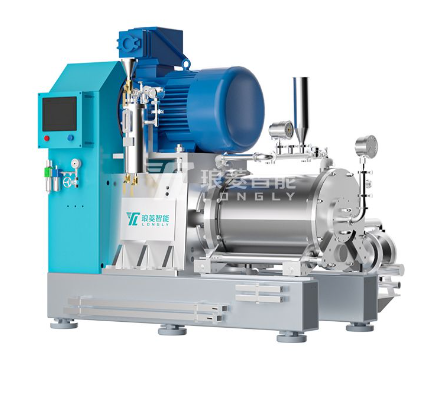
Laboratories usually use nano sand mills with the above direct drive specifications for testing, which can basically meet the vast majority of experimental needs.




 Home
Home