The factors that affect the dispersion and emulsification effect of materials mainly include the following:
1. The form of dispersion and emulsification head;
2. The shear rate of dispersion and emulsification heads;
3. Tooth shaped structure of dispersed and emulsified heads;
4. The residence time of the material in the dispersion chamber;
5. Number of cycles per unit time;
And an excellent dispersion device,
How to solve the above difficulties together?
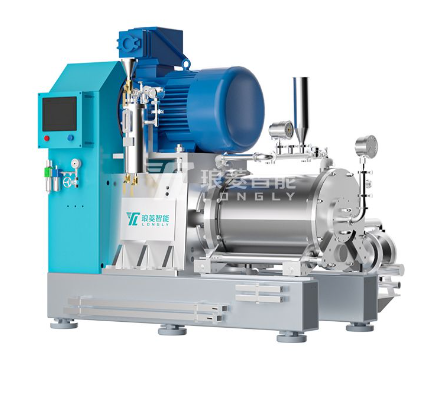
Approaching Langling TRL-C Online Disperser (Solid Liquid Mixing Integrated Machine) together,
Find out!

Modular design for higher efficiency and productivity

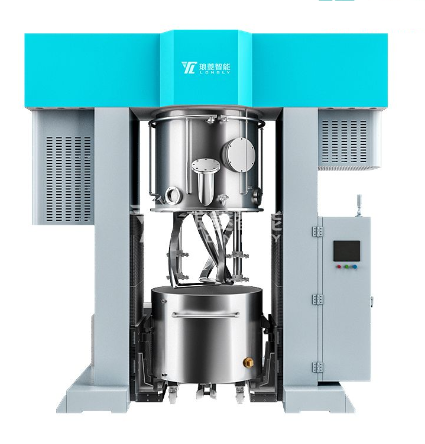
· TRL-C online disperser (solid liquid mixing integrated machine)
Widely used in industries such as lithium batteries, lithium iron phosphate, nanomaterials, coatings, biochemistry, pharmaceuticals, pesticides, etc;

Equipped with PLC intelligent system control, it can achieve full automatic and semi-automatic control mode switching, making it more intelligent, efficient, stable, with lower wear and longer service life. Improve the pumping, mixing, and dispersion effects, and ensure that there are no blind spots in material dispersion.
Efficient structure, more sufficient and uniform dispersion effect

The stator and rotor structure developed and designed according to the Archimedes spiral principle and the centrifugal high-speed rotating mechanics principle can better present a higher linear speed, and the effective dispersion area is larger, without dead angle.
To quickly, uniformly, and delicately disperse, emulsify, homogenize, and dissolve immiscible or difficult to dissolve two-phase or multiphase materials, with the characteristics of large processing capacity, low energy consumption, and good stability, especially suitable for industrial and continuous production.

Imported machine seal, pollution-free, intelligent and energy-saving

Manufactured according to EHEDG (European Health Engineering Design Group) guidelines;
Certified to meet 3A health standards;
The Langling TRL-C online disperser adopts a closed system and a containerized mechanical seal design, which prevents dust from entering and solvent leakage in the cavity, thereby preventing the formation of agglomeration and flocculation phenomena.





 Home
Home