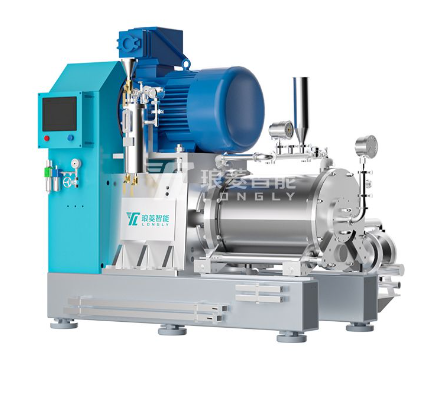
The sand mill is currently a widely adaptable, advanced, and efficient grinding equipment for materials. The grinding chamber is narrow, the lever gap is small, and the grinding energy is dense. Combined with a high-performance cooling system and automatic control system, it can achieve continuous processing and discharge of materials, greatly improving production efficiency.
In recent years, the average annual growth rate of sand mill demand in China has been over 9%. The rapid growth of market demand has brought many application problems. Today, let's take a look at how we can control the grinding efficiency of sand mills in actual production.
1、 Factors affecting grinding efficiency
The physical properties such as density, hardness, and particle size of the grinding medium used in the actual production process of sand mills have a significant impact on the grinding efficiency.
The main factors affecting grinding efficiency include: 1. Reasonable grinding chamber structure; 2. Energy density; 3. Linear speed; 4. The velocity gradient between the grinding media in the grinding chamber (the greater the velocity difference, the more efficient); 5. The grinding medium is fully circulated in the grinding chamber without dead corners; 6. The size, roundness, and specific gravity of the grinding medium; 7. The ratio of material particle size to grinding medium diameter
2、 Control of Linear Speed of Sand Mill
The higher the linear speed of the sand mill, the greater the kinetic energy transmitted to the beads, and the higher the efficiency of the sand mill. But is the higher the linear speed of the sand mill, the better? Of course not! The drawbacks of high linear speed of sand mills are as follows:
The higher the linear speed, the greater the heat generation, and the faster the machine heats up, while most materials have temperature limitations.
The higher the linear speed, the greater the impact on the grinding medium of the sand mill, and the grinding medium prepared is likely to break due to this
The higher the linear speed, the greater the damage caused to the machine, the more severe the wear of parts, and the higher the material requirements for manufacturing the machine.
The truly effective grinding area of a sand grinder is the narrow area between the grinding disc and the barrel wall, with other parts being the heating area; So, using appropriate linear velocity to concentrate the grinding medium within the effective grinding working area can achieve the highest grinding efficiency. At present, the linear speed of sand grinding machines varies from manufacturer to manufacturer, usually between 9-14m/s, and their grinding efficiency is also different.
3、 Control of cooling water temperature
The temperature of cooling water is one of the important factors affecting the grinding efficiency of a sand mill. Under intense motion of the grinding medium, mechanical energy is converted into thermal energy, generating a large amount of heat.
As the temperature increases, the material to be ground will agglomerate and the quality of the finished particles will decrease. The temperature of the cooling water directly affects the working temperature in the grinding chamber, thereby affecting the grinding efficiency.
From some experimental comparisons, it can be found that under the same other conditions, the grinding efficiency of using 15 ℃ chilled water is more than 30% higher than that of using 22 ℃ circulating water. Therefore, controlling the cooling water temperature appropriately can greatly improve the grinding efficiency.




 Home
Home