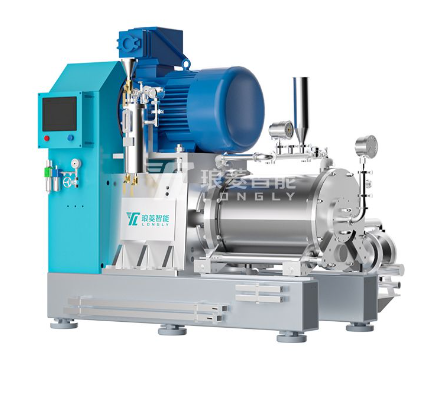
It has always been said, "What is the grinding particle size?" "What is the original particle size?" So how do we convert the term "mesh" to "micrometers" or "nanometers" when grinding materials with a sand mill? Here is a brief introduction to the Langling sanding machine for you
Mesh refers to the number of empty holes on a 1 inch (2.54cm) sieve. One eye means that there are one eyelet per square inch. In addition to representing the mesh size of the sieve, it is also used to represent the particle size that can pass through the sieve. The higher the mesh size, the smaller the particle size. The chemical industry often requires the use of sieve filtration, and according to the diameter of the filtration, it is often necessary to check the mesh size of the sieve everywhere. Here is the simplest and most applicable calculation formula:
Mesh size of the sieve × Diameter of particles to be filtered (microns) = 15000
For example, a 100 mesh sieve can filter out particles with a diameter of approximately 150 microns.
The following table is a comparison table between the number of mesh and particle size commonly used in China:
| mesh | μm | mesh | μm | mesh | μm | mesh | μm |
| 2 | 8000 | 28 | 600 | 100 | 150 | 250 | 58 |
| 3 | 6700 | 30 | 550 | 115 | 125 | 270 | 53 |
| 4 | 4750 | 32 | 500 | 120 | 120 | 300 | 48 |
| 5 | 4000 | 35 | 425 | 125 | 115 | 325 | 45 |
| 6 | 3350 | 40 | 380 | 130 | 113 | 400 | 38 |
| 7 | 2800 | 42 | 355 | 140 | 109 | 500 | 25 |
| 8 | 2360 | 45 | 325 | 150 | 106 | 600 | 23 |
| 10 | 1700 | 48 | 300 | 160 | 96 | 800 | 18 |
| 12 | 1400 | 50 | 270 | 170 | 90 | 1000 | 13 |
| 14 | 1180 | 60 | 250 | 175 | 86 | 1340 | 10 |
| 16 | 1000 | 65 | 230 | 180 | 80 | 2000 | 6.5 |
| 18 | 880 | 70 | 212 | 200 | 75 | 5000 | 2.6 |
| 20 | 830 | 80 | 180 | 230 | 62 | 8000 | 1.6 |
| 24 | 700 | 90 | 160 | 240 | 61 | 10000 | 1.3 |




 Home
Home