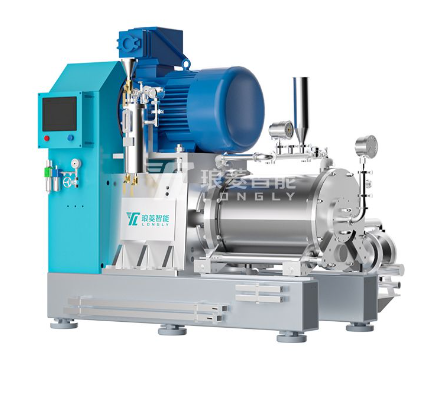
Generally speaking, a color paste grinding machine refers to a grinding machine that can grind to very small fineness and high concentration. It can be a three roller machine or a sand grinder. It depends on which color paste you want to make, so choose a sander.
How to choose grinding equipment for color paste
The production process of suspension is usually based on four considerations: the flow state of powder products or grinding slurry, the dispersion of powder in the slurry, the wettability of the slurry to the powder, and the requirements for product processing accuracy. Firstly, the grinding dispersion equipment used in the process is selected to determine the basic mode of the process.
(1) According to the flow status of the product or grinding slurry, the slurry can be divided into four categories:
① Flowable
Such as enamel, primer, etc;
② Pasty
Such as thick paint, putty, and some thick paste art paints;
③ Color chip
High pigment components such as nitro, perchloroethylene, and polyvinyl butyral as substrates are solid at 20-30 ℃ and become malleable plastic substances upon heating;
④ Solid powder state
For various powder coating products, the dispersion process of pigments in the paint material is carried out in a molten resin, while the final product is in a solid powder state.
(2) According to the difficulty of dispersion in the slurry, pigments can be divided into the following 5 types:
① Fine grained and easily dispersed synthetic pigments
The particle size of the original particles is less than 1um and is relatively easy to disperse in the paint. Such as titanium dioxide, Lithopone, zinc oxide and other inorganic pigments, and red powder, toluidine red and other organic pigments.
② Fine grained and difficult to disperse synthetic pigments
Although its original particle size also belongs to the fine particle type, its structure and surface state determine that it is difficult to disperse in paint materials, such as carbon black, iron blue, etc.
③ Coarse grained natural pigments and fillers
The original particle size is about 5-40um, even larger, such as natural iron oxide red (laterite), barium sulfate, calcium carbonate, talc powder, etc.
④ Micropowdered natural pigments and fillers
The particle size of its original particles is 1-10um, even smaller, such as natural iron oxide red, precipitated barium sulfate, calcium carbonate, talc powder, etc. after ultrafine grinding.
⑤ Abrasive pigment
Such as red lead and non micronized iron oxide red.
(3) According to the wettability of the color of the slurry, it can be divided into the following three categories:
① Good wetting performance
Such as oil-based paint, natural resin paint, phenolic resin paint, and alkyd resin paint;
② Moderate wetting performance
Generally, synthetic resin coatings include epoxy resin coatings, acrylic acid resin coatings, and polyester resin coatings;
③ Poor wetting properties such as nitrocellulose solution, perchloroethylene resin, etc.
(4) According to the different processing accuracy of products, paints can be divided into the following three categories:
① Low precision
Product fineness above 40um;
② Medium precision
The product fineness is between 15-20um;
③ High-precision
The product fineness is below 15um.
A comprehensive consideration of the four factors mentioned above. This is the basis for commonly selecting grinding and dispersing equipment.




 Home
Home