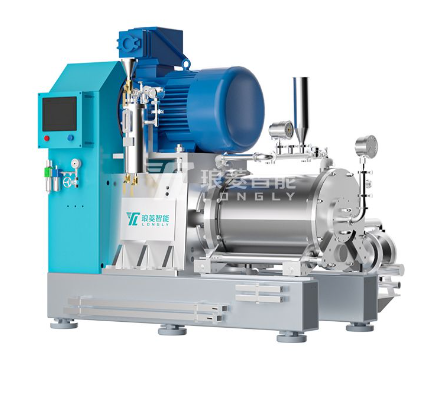
What is a nano grinding machine, as the name suggests, is to further grind the materials we need, finely grinding them according to technical requirements, so that the raw materials can achieve precision and have good results in application. To achieve ideal grinding results, not only efficient equipment but also some techniques are necessary. When grinding, the following aspects should generally be noted.
1. Pre dispersion. Pre dispersion is an essential process of sand grinding using a sand mill. The material entering the sand mill should be uniform. If the feed is uneven, it is not only easy to cause pipeline blockage, but also leads to a decrease in grinding efficiency at the beginning of the grinding stage. Therefore, pre dispersion is necessary.
2. Grinding medium. The grinding medium is the grinding material used in conjunction with the sand mill, and the crushing of materials is achieved through it. Therefore, its physical and chemical indicators and usage methods directly affect the effectiveness of the sand mill, which can be said to be the key to determining the success of the grinding process.
3. Adjust viscosity. The viscosity of the material in the sand mill affects the grinding efficiency. The control of viscosity should vary with the size of the grinding medium. If the particle size of the grinding medium is large, the viscosity can be higher, while if the particle size is small, the viscosity should be lower. Usually, the solid content is controlled at 20% -30% to maintain the viscosity within a certain range.
4. Temperature control. Due to the friction of the medium during the grinding process, heat is generated, resulting in an increase in temperature, which can lead to a decrease in viscosity and may also cause changes in crystal form, resulting in unwanted crystal forms and affecting the application performance of the product. Therefore, lower grinding temperatures are mostly chosen.
5. Process arrangement. Due to the fact that fluorescent whitening agents often require several rounds of grinding to meet their usage requirements, it is necessary to carefully study the arrangement of the process in order to obtain a narrower distribution of material particles and higher grinding efficiency.
6. Control of pH value. In order to maintain the stability of the material and the colloidal dispersion of particles in a good state during the grinding process, it is generally necessary to use acids or alkalis to neutralize the alkalis or acids that are mixed in the crystal or aggregate in the particles (these alkalis or acids will be released during grinding), and the pH is usually controlled to be between 8 and 8.5.
7. Disaggregation. A part of the dispersed fluorescent whitening agent coagulates during grinding or before spray drying of its slurry. In order to make the commodities after spray disperse well, the fluorescent whitening agent can be depolymerized by homogenizer before drying.




 Home
Home