-
- Experimental sand grinder
- Experimental Sand Grinder NT-V Series
- Experimental Sand Grinder NT-VS Series
- Experimental Sand Grinder LSM Series
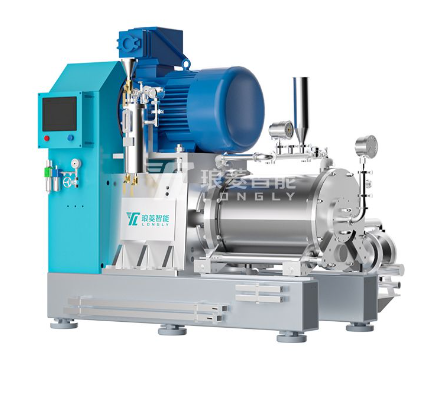

The size and distribution of ceramic powder, as well as the maximum particle size in the raw material powder, affect the quality of the ceramic billet and the subsequent entire process, thereby affecting the quality of the product. At present, most domestic manufacturers still use traditional ball milling technology. Although it is easy to operate and reliable, it has long grinding time, high energy consumption, large particle size of the prepared raw materials, and a wide range of particle size distribution.
The sand mill developed from ball mills belongs to micro and nano ultrafine wet grinding, and has broad applications in the grinding of ceramic powders. The rapid development of technology also puts forward higher requirements for the dispersion of ceramic slurry, and more and more MLCC manufacturers in China are starting to use sand mills to disperse ceramic slurry. In addition, the rapid popularization of ceramic inkjet printing technology in the ceramic industry has directly promoted the rapid development of the sand grinding machine market.
Sand mills, also known as ball mills, are mainly used for wet grinding and have evolved from ball mills. According to their performance, they can be roughly divided into horizontal sanding machines, basket sanding machines, vertical sanding machines, etc. The grinding medium of the equipment is generally divided into alumina beads, zirconia beads, glass bead, zirconium silicate beads, etc. And due to the significant wear and tear during the operation of the sand mill, in order to prevent pollution, it is required to use homogeneous ceramic grinding media when grinding ceramic materials.
According to the development of sand mills, they can be divided into five stages: vertical stirring mill, vertical disc sand mill, vertical pin rod sand mill, horizontal disc sand mill, and horizontal pin rod circulating sand mill.
The structure of the sand mill mainly consists of a slurry barrel, a slurry pump, a grinding chamber, a rotating system, and a cooling system. The main components for dispersion and grinding are the grinding chamber, which is composed of grinding containers, dispersers, separators, and mixing shaft seals.
The working principle of a sand mill is to use a pump to input the pre mixed slurry in the slurry barrel through high-speed stirring into a closed grinding chamber, which comes into contact with the high-speed rotating grinding medium. This causes stronger collision, friction, and shear effects between the solid particles in the material and the grinding medium, achieving the goal of accelerating the grinding of fine particles and dispersing aggregates. The slurry flowing out of the grinding chamber returns to the slurry barrel and the aforementioned dispersion process is repeated again. After several cycles, the required fineness and narrow particle size distribution range are achieved.
There are four main grinding processes for sand mills, namely continuous grinding process, series grinding process, combined cycle grinding process, and single barrel cycle grinding process. The premise of the single barrel cyclic grinding process is that the number of cycles is greater than 5, and a mixer is equipped on the cyclic barrel to ensure full mixing of materials and avoid dead corners in the cyclic barrel. This process has simple operation and low equipment investment, and is generally used for grinding ceramic raw materials such as silicon carbide, silicon nitride, boron carbide, etc.
PREV:No data



 Home
Home