Summary:
The main basis for evaluating the performance of water-based inks is their printability. The determining factors that affect the printability of water-based inks are ink fineness, viscosity, and acidity, while the main factors that affect their fineness, viscosity, and acidity are ink binder components, pigments, and additives.
The dispersion performance of pigments in water-based inks is constrained and influenced by various factors, especially the viscosity and particle size of inks, which have a significant impact on ink quality. This article analyzes and explores the composition and performance of water-based inks, the dispersion performance of pigments themselves in water-based inks, and the impact of pigment dispersion performance on ink printing suitability. It also provides technical reference for methods to improve ink dispersion and stability.
Distribution of pigment particle size
The distribution and size of pigment particle size have a significant impact on the dispersion performance of pigments.
A large amount of experimental data shows that pigments with fine particles and uniform particle size distribution can achieve better dispersion effects. Numerous experiments have shown that the grinding and dispersion time and stirring speed play a crucial role in affecting particle size and distribution, that is, the grinding time and number of passes of pigment powder should not be too long.
☆ Recommended grinding equipment:
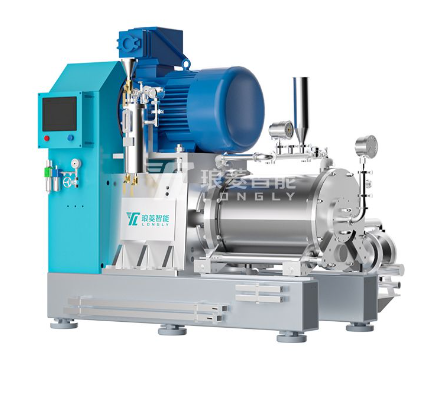
Langling LDM Series - Fourth Generation Rod Pin Intelligent High Efficiency Sand Grinder
Outstanding representatives of "low energy consumption, low cost, and high output"
Upgraded rod-pin grinding structure and high-end power system, with sufficient power, high speed, stable operation, and the ability to use smaller zirconium beads with high flow rate without blockage, making it an ideal choice for high-end paint, coating, and ink grinding.
Compared to ordinary sand mills on the market, it increases production capacity and efficiency by 30-50%.
The rod pin type grinding structure strengthens the impact and shear effects of the grinding beads on the material, improving the dispersion grinding effect;
High filling rate and higher grinding efficiency for grinding zirconium beads;
Imported mechanical sealing technology, tight sealing, no leakage;
Suitable for continuous or batch production, easy to change colors and clean;
Automatic pressure protection device ensures stable pressure in the grinding chamber and fast and uniform grinding;
A comprehensive automatic protection system for electrical appliances to ensure safe production;
Surface structure of pigment particles
Good wetting effect is a necessary prerequisite for successful dispersion.
The wetting degree of the solid surface of pigments is measured by the size of the contact angle. When the contact angle of the solid surface is 0 °, the solid is in a state of complete immersion by water; When it is between 0 ° and 90 °, the solid surface has good hydrophilicity and can be relatively well wetted by water; When the contact angle is between 90 ° and 180 °, the solid surface is in a hydrophobic state and is not easily wetted by water; When the contact angle is 180 °, it happens to be in a state far from the water surface.
Viscosity
There are two main factors that affect the viscosity of water-based ink:
One is temperature. There is a negative correlation between temperature and viscosity, that is, the higher the temperature, the lower the viscosity of ink; The opposite is also true.
The second is the pH value. The pH value of ink does not directly affect the viscosity of ink, but it indirectly affects the viscosity of the connecting material, which directly determines the viscosity of ink. So, the pH value has a great relationship with the viscosity and stability of ink
Dispersion state of pigments
The dispersion state of pigments is determined by the charge reflection between the pigment and the connecting material. When an electric charge is generated between the two, the charged pigment particles will be in a dispersed and stable suspension state.
The dispersion state of pigments has a significant impact on printing quality, mainly manifested in the following four aspects:
① In terms of stability. The stability of pigments in water-based inks is worse than that of ordinary inks. Therefore, in actual printing work, it is necessary to add glue to improve the stability of pigments, and to control the printing speed and pressure during the operation process.
② The presentation of colors. Compared to ordinary ink, water-based ink is resistant to dryness. However, when printing in the dark areas of gravure paper, the ink needs to be fully soaked before printing, which can cause burrs and seriously affect the gloss of the image.
③ The viscosity and water resistance of water-based inks. The viscosity of water-based ink is low, and its stability and water resistance are poor. Therefore, ammonia and amines need to be used for treatment to ensure the viscosity and stability of water-based ink.
④ Dryness and adhesion. The evaporation rate of water in water-based ink is slower than that of solvents, making it difficult to adhere and dry on the surface of printed materials. Therefore, it is necessary to adjust the temperature of the ink by heating to ensure its drying
Surface modification treatment of pigments
In order to ensure good wetting and dispersion properties of pigment particles in water, it is necessary to modify the surface of pigment particles. Wrap the surface treatment agent on the surface of the pigment, and then change the polarity of the pigment to achieve better dispersion effect.




 Home
Home