The output value of the new materials industry is growing at a rate of about 30% annually. Chemical new materials, microelectronics, optoelectronics, and new energy have become the most active, rapidly developing, and highly favored new materials fields for investors. Material innovation has become one of the important driving forces for promoting human civilization progress, as well as promoting technological development and industrial upgrading. Let's briefly talk about several types of new materials and their production equipment, sand mills.
Firstly, composite new materials, high-strength and high modulus fibers can be combined with non-metallic matrices such as synthetic resins, carbon, graphite, ceramics, rubber, or metal matrices such as aluminum, magnesium, and titanium to form unique composite materials. The specific strength of UHMWPE fiber ranks first among all kinds of fibers, especially its excellent chemical resistance and aging resistance. It also has excellent high-frequency sonar permeability and seawater corrosion resistance. Many countries have used it to manufacture high-frequency sonar fairs for ships, greatly improving their mine detection and clearance capabilities. Whether it is non-metallic materials such as carbon, graphite, ceramics, rubber, or metals such as aluminum, magnesium, and titanium, these composite materials collectively need to be ground into nanoscale materials by a sand mill;

Secondly, magnetic materials refer to materials that are easy to magnetize and can be repeatedly magnetized, but when the magnetic field is removed, the magnetism disappears. Magnetic materials are divided into permanent magnet materials and soft magnet materials, commonly used soft magnets include iron silicon alloy, iron nickel alloy, and amorphous metal. After magnetization, permanent magnet materials retain their magnetism even after removing the external magnetic field, and their performance characteristics are high remanence and high coercivity; By utilizing this feature, permanent magnets can be manufactured and used as magnetic sources, such as common compasses, instruments, micro motors, electric motors, tape recorders, telephones, and medical devices. Magnetic materials used in many instruments, medical and other fields require grinding with a sand mill to a certain particle size.
Thirdly, the preparation and synthesis technology of nanomaterials is currently the main research direction. Although some progress has been made in sample synthesis, a large number of bulk samples have not yet been prepared. Therefore, studying the preparation of nanomaterials plays a crucial role in their applications. For example, nano ceramics: firstly, nano powders can reduce the sintering temperature of ceramics and simplify the production process. At the same time, nano ceramics have good plasticity and even superplasticity, which solves the weakness of ordinary ceramics with insufficient toughness and greatly expands the application field of ceramics; There are also new nano materials such as carbon nanotubes and nanocatalysts, and the production of these materials requires the production and grinding of nano sand mills.

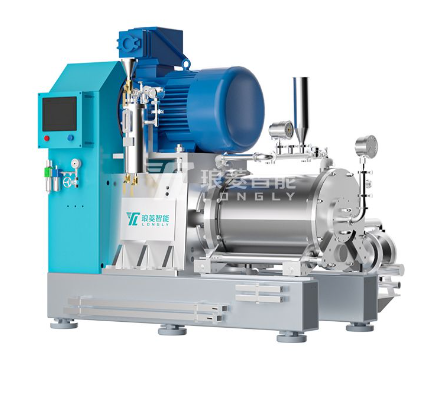
The sand mill is mainly used for wet grinding of chemical liquid products. It is the most adaptable, advanced, and efficient grinding equipment for materials. The grinding chamber is the narrowest, the lever clearance is the smallest, and the grinding energy is the densest. Combined with high-performance cooling systems and automatic control systems, it can achieve continuous processing and discharge of materials, greatly improving production efficiency. The sand mill uses a material pump to input the solid-liquid mixture material that has been pre dispersed and wetted by a mixer into the cylinder. The material and the grinding medium inside the cylinder are stirred by a high-speed rotating disperser, resulting in stronger collision, friction, and shear effects between the solid particles in the material and the grinding medium, achieving the goal of accelerating the grinding of fine particles and dispersed aggregates.




 Home
Home