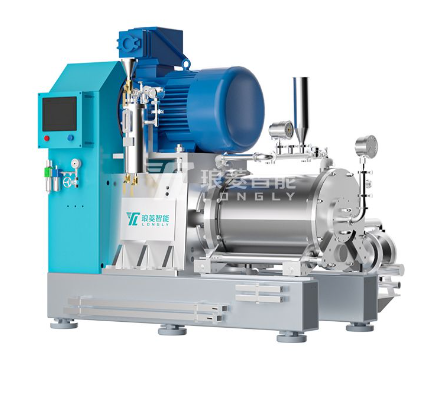
Rod pin sanding machine is suitable for ultrafine dispersion and nanoscale grinding of water-based and solvent based materials. Its application range includes ink, paint, dyes, pigments, fillers, pharmaceuticals, printing, inkjet, cosmetics, hot paper coatings, etc. It can meet the requirements of fineness indicators for various types of chemical products. The particle size distribution of the product is extremely narrow, with high grinding efficiency and large output, which can reduce energy consumption. The product fineness can reach below the nanometer level.
The volume of the grinding cylinder of the rod pin sand mill can be adjusted freely, which can effectively control the temperature, fineness, and wear of the grinding medium. The dual cooling of the inner rotor and outer jacket of the bar pin horizontal sanding machine has a very good cooling effect on the material. The rod pin sand grinder mainly adopts a conical cylindrical structure, which increases the grinding stroke and has higher efficiency.

The rod pin horizontal sanding machine mainly adopts a rod pin structure, suitable for grinding materials that are extremely difficult to disperse. After grinding, the dispersion effect can be achieved. Suitable for products with high viscosity. The hard alloy steel of the rod pin grinder and the ceramic rod pin grinding system are sealed without leakage, using a liquid that can dissolve with the material as a coolant, without pollution, and are more durable. The rod pin sander mainly uses micro grinding media with low wear. Before starting the rod pin nano sand mill, it is necessary to pay attention to the following items: whether the cooling water flows, whether the cooling flow rate is appropriate, and whether the cooling temperature setting is reasonable; Detect the air pressure and check whether the input air pressure meets the design input standards; Check the power supply and check if the power supply to the power cabinet is normal.




 Home
Home