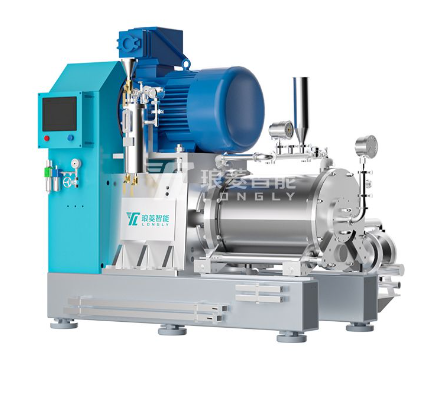
Which sander is better than Langling Intelligent? For this issue, what you may want to understand at the beginning is not the problem itself, or you may have entered a misconception. You should understand which type of sand mill is more suitable for using Langling Intelligent in your own factory, rather than thinking about which one is better. As the saying goes, what suits oneself is the best.
For example, there are some companies that only produce general paints, coatings, color pastes, and the particles of materials may only be a few tens of micrometers. For such companies, general business personnel will recommend the LBM series of blue sand grinding machines to customers. This sand grinding machine has a relatively low price, can meet customer requirements, and has better and simpler color materials. Of course, if the company wants something better, they can recommend LDM series, NT-V series, NT-X series, and even LS series to customers. But this requires higher equipment costs, and of course, the fineness that can be ground will be smaller, which will definitely meet the company's requirements.
Of course, there are also some companies that make paints, coatings, color pastes, etc., but they are relatively high-end. They have specific requirements for the particle fineness of materials, and may also have certain requirements for the fineness distribution. So, generally, the business personnel of Langling will recommend the LSM series of disc sanders or the LDM series of rod pin sanders to customers; These two sand mills can grind to a fineness of 1-15 microns. For particle size requirements above 10 microns, the LSM series is generally recommended, while for particle size requirements below 10 microns, the LDM series is generally recommended. Of course, similarly, if the company wants something better, it can recommend the NT-V series, NT-X series, and even the LS series to customers. But this requires higher equipment costs, and of course, the fineness that can be ground will be smaller, which will definitely meet the company's requirements. Of course, the LBM series of Langling Blue Sand Grinder cannot meet the company's requirements.
There are also companies producing new nano materials. Generally, such companies have clear requirements on the particle fineness of materials, and may also have certain requirements on the fineness distribution. Because customers require the fineness of material grinding to reach the nanometer level, Langling's business personnel generally recommend the NT-V series of rod pin type nanoscale sand mills, the NT-X series of turbine type sand mills, or the NT-S series of dual power nanoscale sand mills and the LS-K/Q series of vertical sand mills to customers. The NT-V series and NT-X series can generally grind to a fineness of up to 100 nanometers. The NT-S series and LS-K/Q series can achieve grinding fineness of tens of nanometers. At this point, the company needs to choose different styles and models based on the requirements of nano new materials.
Of course, no matter what type of sander it is, there are also many types of materials to choose from (the rotor and grinding barrel of the sander). Generally speaking, the materials used for grinding barrels and rotors can be tungsten carbide, polyurethane, silicon carbide, wear-resistant steel, zirconia, etc. Many new nanomaterials require that there should be no metal pollution, so the material of the grinding barrel and rotor of the sand mill must be ceramic material, and the grinding effect and wear resistance of the sand mill also need to be considered. There may be different styles and models.
PREV:No data




 Home
Home